Quick links
- What the Sewer Line Is and Where Problems Start
- Warning Signs of a Damaged Sewer Line
- Common Causes of Sewer Line Damage
- How a Plumber Diagnoses Sewer Problems
- Sewer Repair Options: From Spot Repair to Full Replacement
- Sewer Line Replacement and Installation
- What Affects Sewer Repair Cost
- Septic Systems and Cesspools
- Emergency Sewer Backups
- Sewer Cleaning, Cleanouts and Maintenance
- How to Prepare for a Sewer Inspection or Repair Visit
- Roots, Trees and Landscaping
- Commercial and Multi-Unit Sewer Lines
- Buying, Selling and Documenting a Property with an Old Sewer Line
- Signs the Problem May Not Be the Sewer at All
- Choosing Sewer Line Contractors
- Related Systems: Leaks, Water Lines and Drains
- Where You Can Get Help
- Related Plumbing Help
- Frequently Asked Questions
Sewer line repair fixes the underground pipe that carries wastewater from your house to the municipal main or septic tank, and the right method depends on what is wrong: a blockage, a crack, a root intrusion, a bellied section or a full collapse. A camera inspection tells you which. Repair can mean spot digging, lining the pipe without a trench, or replacing the whole run.
Your sewer line is out of sight, so problems tend to show up as backups, slow drains in several fixtures, gurgling toilets, wet patches in the yard or a sewer smell. This overview explains what causes damage, how it is diagnosed, which repair path suits which problem, and what drives the price. Availability and quotes are confirmed by phone.
What the Sewer Line Is and Where Problems Start
The sewer line, also called the lateral, is the buried pipe running from the house drain, through your yard, to the public sewer main in the street or to a septic tank. Everything you flush or drain passes through it, so it is the last place you want a failure.
The parts that matter
- The house drain collects waste from all fixtures inside.
- The cleanout is a capped access point, often near the foundation or at the property line.
- The lateral is the buried run, commonly clay, cast iron, Orangeburg (bituminized fiber), PVC or ABS depending on the era.
- The tap or connection joins your line to the main.
Who owns what
Responsibility varies. In many places the homeowner owns the lateral all the way to the main, while some cities own the portion in the street or under the sidewalk. Check with your local utility or ask the plumber how ownership works where you live.
Warning Signs of a Damaged Sewer Line
The classic warning is water backing up in the lowest fixture when you run another one. Others include repeated clogs, gurgling, sewage smell, lush patches of grass over the line, or sinkholes in the yard.
- Several fixtures drain slowly at the same time.
- A toilet bubbles when the washing machine drains.
- Sewer odor in the yard or basement.
- Unexplained damp soil or a soft spot along the pipe path.
- Rodents or insects appearing from drains.
- Foundation cracks or settling in extreme cases.
A single slow drain is often just a local clog, so start with drain cleaning before assuming the sewer is broken. If cleaning brings only short relief, a sewer problem is more likely.
Water still running or a smell of gas? Act first, then call.
Call 417-261-5030Common Causes of Sewer Line Damage
Tree roots, age, ground movement, poor original installation and flushed materials are the main causes. Sewer leak repair and sewer line leak repair jobs are usually traced to one of these.
Roots
Roots seek water and nutrients, and a small joint gap is enough to let them in. Once inside, they grow into a mass that snags paper and slows flow. Cutting them clears the line temporarily, but unrepaired joints invite them back.
Aging pipe materials
Clay joints loosen, cast iron corrodes from the inside, and Orangeburg pipe softens and deforms with age. In older neighborhoods, a broken sewer line repair often follows decades of gradual wear rather than one event.
Shifting ground and heavy loads
Soil settlement, freeze and thaw cycles, construction and vehicles driving over a shallow line can crush or offset pipe sections. Belly sections, where the pipe sags and holds water, form when the bedding underneath washes out.
What goes down the drain
Grease, wipes marketed as flushable and other solids can build up in a weak spot and create a blockage that repeats.
How a Plumber Diagnoses Sewer Problems
Diagnosis starts with the symptoms and a camera. A waterproof camera on a flexible cable travels through the pipe from the cleanout, recording cracks, roots, offsets, bellies and collapse. The video shows the exact position and depth.
Sewer camera inspection
Searches for a sewer camera, drain camera and plumbing camera show that homeowners increasingly want to see the pipe before spending money. A locator on the surface marks where the camera head is, so a spot repair can be planned precisely. The full process is in sewer camera inspection and sewer scope.
Buying a home
A pre-purchase sewer scope is a routine step for many buyers of older properties, because a failing lateral is expensive and not visible during an ordinary home inspection. Ask for a recording you can keep.
Sewer Repair Options: From Spot Repair to Full Replacement
The main routes are spot repair, trenchless lining or pipe bursting, and full trench replacement. Sewer repair, sewer repairs and sewage repair all point to the same decision: match the method to the damage.
Spot repair
When a single section is cracked or offset, the plumber excavates that section and replaces it. It costs less than full replacement, but works only when the rest of the pipe is sound.
Trenchless repair
Trenchless sewer repair, trenchless pipe repair and trenchless sewer line repair use small access holes to line or replace pipe with minimal digging. Lining creates a new pipe inside the old one; pipe bursting pulls a new pipe through as the old one is broken apart. It protects landscaping, driveways and patios, though it is not suitable for every failure. Details are in trenchless pipe repair and pipe relining.
Full replacement
When the pipe is collapsed, severely bellied or made of failing material along most of its length, replacing it is the durable answer. See sewer line replacement and repair cost for how decisions and pricing work.
Sewer Line Replacement and Installation
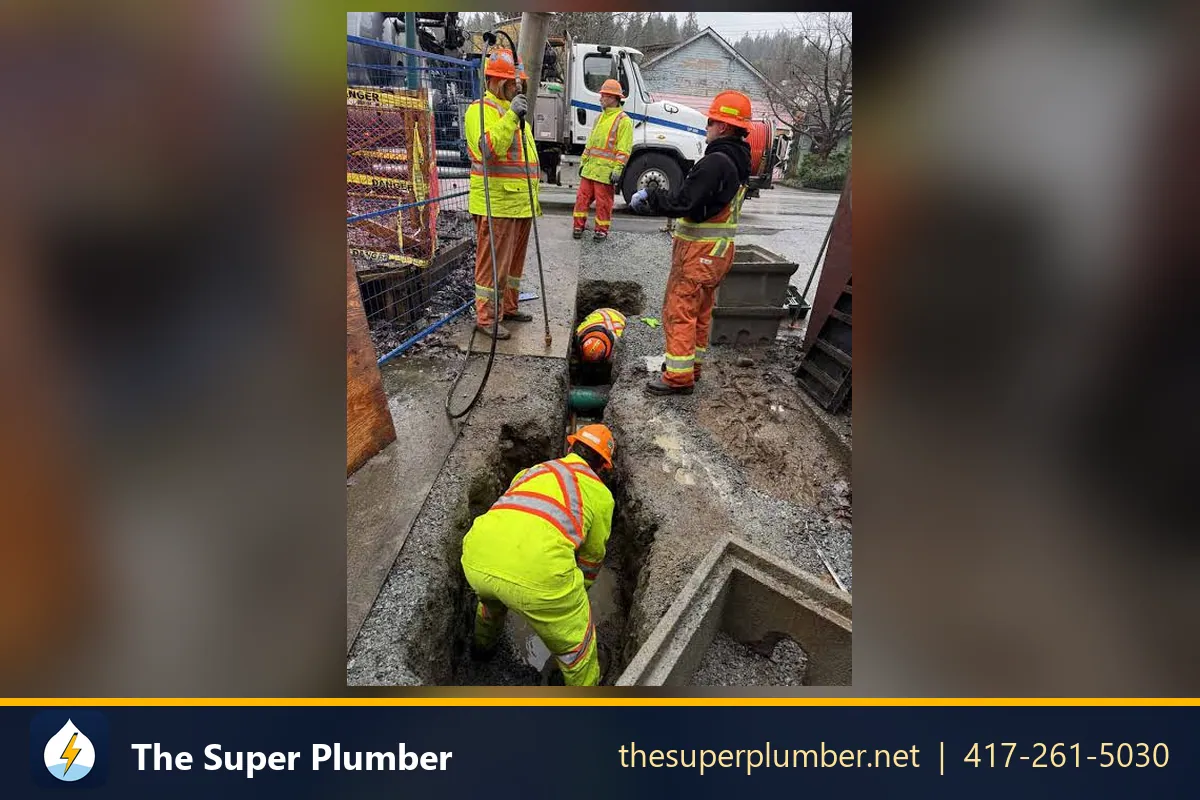
Sewer line replacement services and sewer pipe replacement near me searches usually come from homeowners who have been told the pipe is beyond repair. Replacement removes the old lateral and installs a new one, either in an open trench or by a trenchless method.
A sewer line installation near me request might also cover a new home, an addition, or connecting an accessory building. New lines need the correct slope, bedding, cleanout placement and inspection by the local authority.
- A permit is commonly required, and utility marking of buried lines happens before digging.
- Materials such as PVC or ABS are common for new work, subject to local code.
- The connection to the city main may need separate approval.
- Restoration of landscaping and paving is part of the planning.
For homeowners with a sewer lateral replacement near me need, ask who is responsible for the portion under the street. If pipes near your water service also need work, water main repair covers the neighboring line.
Not sure what you need? Call and we will point you to the right help.
Call 417-261-5030What Affects Sewer Repair Cost
Cost depends on depth, length, access, pipe material, method, permits, and what sits above the line. Numbers are confirmed by phone after the problem is understood, and any figure quoted without a camera look should be treated with caution.
Factors that move the price
- Length of pipe that needs work.
- Depth, since deeper trenches need shoring and more labor.
- Obstacles, such as trees, driveways, patios, utilities and fences.
- Method, spot repair versus lining versus full replacement.
- Restoration, including concrete, landscaping and pavers.
- Permits and inspections in your city.
Cleaning costs
Searches like how much to snake sewer line and unclog sewer line cost reflect that many homeowners start with cleaning. A cleaning is much cheaper than a repair, but only lasts if the pipe is otherwise sound. See sewer line cleaning for what cleaning involves.
Septic Systems and Cesspools
If your house is not connected to a municipal sewer, the line runs to a septic tank or a cesspool. People search for a septic plumber near me, septic tank plumbing near me, septic line repair near me and septic and plumbing services near me for exactly this reason.
What differs on septic
The pipe from the house to the tank is a sewer line too, and it can clog or crack in the same ways. Beyond the tank, the drain field has its own maintenance needs. Septic cleaning companies, a septic drain service or septic line cleaning near me handle pumping and cleaning, and a cesspool pumping service handles older systems. Some plumbers cover both sides and some do not.
- Pumping schedules depend on tank size and household use.
- Backups can come from a full tank rather than a blocked pipe.
- Never enter a tank or lid opening yourself; gases are dangerous.
- Keep vehicles and heavy loads off the tank and field.
Ask any contractor about septic and sewer services near me to confirm they handle the part of the system that is failing.
Emergency Sewer Backups
A sewage backup is an emergency because it is unsanitary and can damage floors, walls and belongings quickly. Stop using water, keep people and pets out, avoid touching the liquid, and phone for urgent help. Availability of a 24 hour plumber or same day plumber is confirmed when you call.
What to do right away
- Stop running sinks, showers, washers and toilets.
- Turn off electricity to affected areas only if the panel is dry and safely reachable.
- Open windows for ventilation if the weather allows.
- Photograph damage for your insurance record.
- Keep children, pets and anyone with health concerns away.
Do not attempt to clean up sewage yourself, do not enter standing sewage, and do not mix chemicals in the line. More detail on urgent situations is in emergency plumbing.

Sewer Cleaning, Cleanouts and Maintenance
Regular maintenance is cheaper than repair. A sewer cleanout services visit locates the cleanout, opens it safely and runs a cable or jetter to clear the line. It also gives a chance to run a camera and record the condition of the pipe.
- Install a cleanout if your line has none; it makes every future visit simpler.
- Keep the cleanout cap accessible and undamaged.
- Schedule cleaning if you have a history of roots.
- Use a camera every few years on older lines.
- Avoid flushing wipes and grease.
For stubborn buildup, the methods in hydro jetting can wash the pipe walls instead of just opening a hole.
Need a plumber in your area? Call to confirm coverage.
Call 417-261-5030How to Prepare for a Sewer Inspection or Repair Visit
Preparation makes the visit faster and the answer clearer. Find the cleanout, clear the space around it, and write down when symptoms started and which fixtures are affected.
- Locate any old plans, permits or repair paperwork for the line.
- Move vehicles, planters and furniture away from the work area.
- Tell the plumber about past root cutting, lining or patch repairs.
- Note where the water meter, main shutoff and landscaping irrigation lines are.
- Arrange for someone to be home to approve findings and next steps.
After the visit, ask for the camera recording, a written description of what was found and a clear list of options. A good explanation covers what happens if you wait, what a temporary fix would achieve and what a lasting repair involves. Keeping the recording lets you compare quotes from other contractors without paying for a second inspection. If the news is bad, take a day to review the options calmly, unless sewage is actively backing up, in which case stopping water use and getting the line cleared comes first.
Roots, Trees and Landscaping
Roots enter through small defects, and no chemical or cut will keep them out for good. Planting choices matter: fast-growing, water-seeking trees near the lateral are the usual offenders.
Managing roots
- Know where the lateral runs before planting.
- Keep large trees a sensible distance from the line.
- Have roots cut and the joint repaired, not just cleared.
- Consider lining, which seals joints against future entry.
Tree removal alone rarely solves the problem, because roots left behind continue to grow. A camera tells you how much of the pipe is affected.
Commercial and Multi-Unit Sewer Lines
Commercial sewer line services cover restaurants, offices, retail spaces and apartment complexes, where the line is bigger, used more and harder to shut down. A blockage can close a business, so planning around downtime matters.
A commercial contractor also has to consider grease interceptors, floor drains, shared laterals and coordination with property managers. Landlords should keep inspection records and share them with tenants after work. Related coverage is in commercial plumbing, and it can help to review local plumbers for how coverage is confirmed.
Buying, Selling and Documenting a Property with an Old Sewer Line
A sewer line problem can change a real estate deal, so both sides benefit from knowing the pipe's condition early. Sellers who scope the line before putting a home on the market avoid surprises during negotiation, and buyers gain leverage or peace of mind.
For buyers
Ask whether a recorded camera inspection exists, note the pipe material and the age of the house, and find out whether a previous repair or lining was done. A recording that shows the whole run to the main is far more useful than a verbal description.
For sellers and landlords
Keep receipts, permits and camera footage together in one folder. If a repair was made, note the method and any warranty paperwork. Landlords with several properties can track which lines have roots or repeated backups and plan maintenance before a tenant is affected.

Signs the Problem May Not Be the Sewer at All
Not every backup is a buried-pipe failure. A toilet that will not flush properly may have a local clog or a flushing problem inside the tank, and a gurgling sink may only need a vent cleared. Ruling these out saves money.
- A single toilet that acts up while other fixtures run fine is often a local issue; see toilet not flushing.
- Slow drainage in one bathroom points to a branch line.
- A blocked plumbing vent on the roof can cause gurgling and slow flow.
- Water on the basement floor after rain may come from groundwater rather than sewage.
- Backups only when the sump pump runs suggest a separate drainage issue, discussed in sump and well pump repair.
What a plumber checks first
The technician will run water in several fixtures, listen for gurgling, check the cleanout for standing water and then decide whether a camera is needed. If the cleanout is full, the problem is in the buried line. If it is empty, the blockage is probably inside the house.
Choosing Sewer Line Contractors
The right contractor explains the problem with video, offers more than one option when possible, and puts the scope in writing. Searches such as sewer line contractors near me, sewer company near me, sewer service near me, sewer repair companies near me and sewer line companies near me return many names, so ask specific questions.
Questions worth asking
- Will you inspect the line with a camera and share the recording?
- Is the quote for spot repair, lining or replacement, and why?
- Who pulls the permit and schedules inspections?
- How will the yard, driveway or patio be restored?
- What warranty applies to the work, and what does it cover?
- Do you also handle water main and sewer contractors near me requests, or only sewer work?
Look at plumber cost for ideas on comparing written quotes.
Where You Can Get Sewer Line Repair & Replacement Help
Plumbing calls are taken for 21 states, 1,511 cities and 3,769 ZIP codes. Pick your state, or look at a sample city and ZIP for each state; coverage for your exact address is confirmed by phone.
- Arizona
- California
- Colorado
- Connecticut
- Florida
- Georgia
- Idaho
- Illinois
- Maine
- Massachusetts
- Michigan
- Minnesota
- Missouri
- New Hampshire
- New Jersey
- New York
- North Carolina
- Ohio
- Texas
- Virginia
- Washington
| City | ZIP codes and places |
|---|---|
| Scottsdale, AZ | 85250 about 2 miles from Salt River Fields at Talking Stick; about 2.3 miles from Scottsdale Museum of Contemporary Art 85251 near Scottsdale Museum of Contemporary Art; near Scottsdale Stadium |
| San Jose, CA | 95025 near St. James Park; near SAP Center 95101 near Silicon Valley University; about 3 miles from San Jose International Airport |
| Colorado Springs, CO | 80901 near Colorado Springs Fine Arts Center; about 1 mile from Colorado College 80906 about 1.4 miles from Broadmoor World Arena; about 1.6 miles from World Figure Skating Hall of Fame |
| Fairfield, CT | 06430 near Rafferty Stadium; about 2 miles from Fairfield University 06828 about 1.3 miles from Rafferty Stadium; about 2.2 miles from University of Bridgeport |
| Pensacola, FL | 32501 about 1.1 miles from Plaza Ferdinand VII; about 1.2 miles from Pensacola Museum of Art 32502 near Blue Wahoos Stadium; near Plaza Ferdinand VII |
| Gainesville, GA | 30501 near Brenau University; about 2.4 miles from Lee Gilmer Memorial Airport 30503 about 7 miles from Lake Lanier; about 8 miles from Brenau University |
| Nampa, ID | 83651 about 1.8 miles from Northwest Nazarene University; about 3.1 miles from Nampa Municipal Airport 83652 about 4.6 miles from Caldwell Industrial Airport; about 4.7 miles from College of Idaho |
| Chicago, IL | 60601 near St. Regis Chicago; near Maggie Daley Park 60602 near Tribeca Flashpoint Media Arts Academy; near Chicago Opera House |
| Eliot, ME | 03903 about 4 miles from Prescott Park; about 4.1 miles from Strawbery Banke |
| Auburn, MA | 02135 near Saint John's Seminary; near The Auerbach Center 02152 about 1.6 miles from Logan International Airport; about 2.2 miles from Revere Beach |
| Clinton Township, MI | 48035 about 8 miles from Jimmy John's Field; about 14 miles from Lake Saint Clair |
| Maple Plain, MN | 55359 about 7 miles from Crown College; about 7 miles from Lake Minnetonka |
| Chesterfield, MO | 63005 about 3.2 miles from Hardee's Iceplex; about 3.9 miles from Logan University 63006 near Hardee's Iceplex; about 1.9 miles from Butterfly House, Missouri Botanical Garden |
| Hampton, NH | 03842 about 3.1 miles from Fuller Gardens; about 8 miles from Bartlett Museum, Inc. 03843 about 10 miles from University of New Hampshire; about 10 miles from Whittemore Center |
| Jersey City, NJ | 07097 near Mana Contemporary; near Saint Peter's University 07302 near Hamilton Park; near Headroom LGBTQ+ Lounge |
| Old Westbury, NY | 11568 near State University of New York at Old Westbury; about 1.1 miles from Old Westbury Gardens |
| Concord, NC | 28025 about 9 miles from Charlotte Motor Speedway; about 10 miles from CMC-NorthEast Stadium 28026 about 8 miles from Charlotte Motor Speedway; about 19 miles from Spectrum Center |
| Springfield, OH | 45501 near Wittenberg University; about 2.3 miles from Clark State College 45502 near Wittenberg University; about 2 miles from Clark State College |
| Houston, TX | 77058 near University of Houston–Clear Lake; about 1.1 miles from Lyndon B. Johnson Space Center 77062 about 1.4 miles from University of Houston–Clear Lake; about 2.1 miles from Lunar and Planetary Institute |
| Newport News, VA | 23601 about 1.5 miles from The Mariners' Museum; about 1.6 miles from Virginia Living Museum 23603 about 1.1 miles from Endview Plantation Historic Site; about 4.2 miles from Busch Gardens Williamsburg |
| Lakewood, WA | 98439 about 1.7 miles from McChord Field; about 2.5 miles from American Lake 98496 about 2.5 miles from McChord Field; about 2.7 miles from Fort Steilacoom |
Frequently Asked Questions
How do I know if my sewer line is broken?
Signs include multiple fixtures draining slowly, backups in the lowest tub or floor drain, gurgling toilets, sewer smell, and wet or sunken spots in the yard. A camera inspection is the reliable way to confirm a break, since it shows the pipe from the inside and marks the location.
Can a sewer line be repaired without digging up my yard?
Often yes. Trenchless options such as pipe lining and pipe bursting need only small access holes. They do not suit every problem, particularly a fully collapsed or badly offset pipe. A camera inspection helps decide whether trenchless work is possible on your line.
Who is responsible for the sewer line, me or the city?
It varies by location. Many homeowners own the lateral from the house to the main, while some cities own the section under the street or sidewalk. Ask your local utility, or check your records, and confirm with your plumber before work begins.
How long does sewer line repair take?
Time depends on the method, depth, length and permits. A spot repair may take a day, while a full replacement takes longer and may involve inspections and restoration. A trenchless job often shortens the disturbance. Your plumber can give a schedule after seeing the camera footage.
Will insurance cover sewer line repair?
Coverage varies by policy. Some policies cover sudden damage but exclude wear, roots or aging pipe, and some offer an optional endorsement. Read your policy and ask your insurer before work begins. Keep photos and camera recordings, because they support any claim.
What is a sewer scope inspection?
A sewer scope is a camera inspection of the main lateral, usually run through a cleanout. It records the condition of the pipe and shows cracks, roots, bellies and blockages. Buyers of older homes often request one before closing.
Is a sewer backup dangerous?
Yes. Sewage contains bacteria and other contaminants, and it can damage floors and drywall. Avoid contact, stop using water, keep pets and children away, and call for emergency help. Professionals should handle cleanup of contaminated materials.
Why does my sewer line keep backing up?
Repeated backups usually point to roots, a bellied section, a partly collapsed pipe or a buildup that cleaning has not removed. Cleaning may bring temporary relief. A camera identifies the cause so you can decide between repeated maintenance and a permanent repair.
Can tree roots be killed in a sewer line?
Some products claim to slow root growth, but they do not repair the opening where roots enter. Mechanical cutting or jetting removes roots, and lining or replacement seals the entry point. Discuss the tradeoffs with a plumber before using any chemical in a sewer line.
How do I find my sewer cleanout?
Look for a capped pipe, often three to four inches wide, near the foundation, in a basement or crawlspace, or in the yard along the line to the street. If you cannot find one, a plumber can locate the line and may recommend installing a cleanout.
Do septic plumbers also repair sewer lines?
Some do, and some specialize in only one side. The pipe from the house to the tank is a sewer line, while the tank and drain field are the septic system. When you call, describe the whole problem so the right service is scheduled.
Is sewer line replacement a permit job?
Usually, yes. Most jurisdictions require permits and inspections for a new or replaced sewer line, and utility locates happen before digging. Ask your contractor who pulls the permit and whether it is part of the quote.
Ready to talk to a plumber? Call 417-261-5030.
Call 417-261-5030