Quick links
- What plumbing installation covers
- Plumbing components: what goes into a system
- Materials: choosing pipe for the job
- Planning a plumbing installation
- Bathroom remodeling and bathroom renovation plumbing
- Kitchen plumbing installation
- Water heaters, water lines and gas in installation projects
- Plumbing video inspection before you build or buy
- Plumbing replacement: when to replace rather than add
- Water plumber work: what to expect on the job
- Installation in older homes versus newer homes
- Common installation mistakes to avoid
- Cost factors for plumbing installation
- Commercial and multi-unit installation
- How to choose an installer
- Myths about plumbing installation
- Caring for new plumbing after installation
- When installation trouble becomes an emergency
- What to have ready before you call
- Where You Can Get Help
- Related Plumbing Help
- Frequently Asked Questions
Plumbing installation is the work of putting in the pipes, fixtures, valves, drains and vents that make a building function, whether that is a single new fixture, a rebuilt bathroom, a kitchen addition or the plumbing for an entire new house. The job has three parts that must agree with each other: water supply in, waste and vent out, and the fixtures that connect the two. Getting the layout, materials and permits right at the start is what keeps a project from turning into leaks and rework later.
This overview explains how installation work is planned and done, which materials and plumbing components are involved, how remodels differ from new construction, and what drives cost. It also introduces detailed help on bathroom remodel plumbing and links to the fixture-specific work that most projects include.
What plumbing installation covers
Installation includes anything new or relocated: fixtures, supply piping, drain-waste-vent piping, water heaters, shutoffs, gas connections and appliance hookups. It is different from repair, which restores something that already exists, and different from plumbing replacement, which swaps out worn pipes or fixtures for new ones.
The main types of installation work
- New construction: rough-in and finish plumbing for a new home or addition.
- Remodels: moving or upgrading fixtures during a bathroom or kitchen renovation.
- Fixture installation: setting a toilet, sink, tub, shower, faucet or disposal.
- Appliance hookups: water heaters, dishwashers, washing machines and refrigerator lines.
- Repiping and replacement: swapping old supply or drain pipe for new.
- Outdoor and utility work: hose bibs, irrigation connections, sump systems and gas lines.
New plumbing installation versus remodel plumbing
New plumbing installation in a new build is easiest because walls and floors are open and the layout is free. Remodel work has to connect to existing lines, work around finished surfaces and often deal with older materials and hidden conditions. That is why remodel estimates carry more caveats than new-build ones.
Rough-in and finish: two stages of one job
Most projects run in two stages. Rough-in is the piping inside the walls and floors, installed before drywall and flooring and then inspected. Finish is the setting of fixtures, trim and connections after surfaces are complete. The stages may be days or weeks apart, and inspections often occur between them.
Plumbing components: what goes into a system
A building's plumbing has three systems that work together: supply, drain-waste-vent and fixtures. Knowing the plumbing components helps you read a quote and understand what you are paying for.
Supply components
- Main shutoff valve and meter connection.
- Pressure reducing valve where street pressure is high.
- Supply piping, commonly copper or PEX inside the building.
- Fixture shutoff valves, also called angle stops or stop valves.
- Water heater connections, including a relief valve and expansion control where required.
Drain, waste and vent components
- Drain piping and fittings, such as PVC, ABS or cast iron, sized for the fixture load.
- Traps, the curved sections that hold water and block sewer gas.
- Vents, which let air in so drains flow and traps keep their seals.
- Cleanouts, capped openings that give access for clearing lines.
- Sump pits and pumps where drainage must be lifted.
Fixture components and small parts
Fixtures come with their own set of parts. Kitchen plumbing parts include the faucet, supply lines, strainer, tailpiece, trap and often a disposal and dishwasher connection. Bathroom fixtures have flanges, valves, drains, overflow assemblies and seals. Mixing incompatible parts is a leading cause of leaks after installation.
Need a plumber in your area? Call to confirm coverage.
Call 417-261-5030Materials: choosing pipe for the job
The best material depends on the application, local code, budget and the condition of what already exists. A plumber should be able to explain why a particular material is chosen.
- Copper: durable, heat tolerant and widely used for supply lines.
- PEX: flexible plastic tubing that installs quickly and resists freezing damage better than rigid pipe, though it has its own rules for sunlight and connections.
- CPVC: rigid plastic used for hot and cold supply in some regions.
- PVC and ABS: common for drain, waste and vent piping, with specific rules for where each is allowed.
- Cast iron: used for quiet drain stacks in many buildings.
- Galvanized steel: found in older homes and typically replaced instead of extended.
Connecting different metals without the right fittings can cause galvanic corrosion, and mixing old and new pipe types requires proper transition fittings. Ask what transitions are planned.
Planning a plumbing installation
Good planning takes place before anyone cuts a wall. The main questions concern layout, capacity, code and access.
Layout and fixture placement
Fixture placement matters: fixtures that sit close together and near existing stacks are cheaper to plumb than those moved to the far side of the house. A drain needs slope, and a vent needs a path, so the layout is limited by structure, joists and floor thickness. Moving a toilet is often the most complicated relocation because of its large drain.
Capacity: supply, drain and water heating
New fixtures add load. A plumber checks whether the existing supply line size, water pressure, water heater capacity and drain size can handle it. A large soaking tub, multiple shower heads or a bathroom addition may call for an upgraded water heater or a larger supply branch. See water heater installation for that side of a project.
Permits and inspections
Most jurisdictions require permits for new or altered plumbing and inspect the rough-in and finish stages. Rules differ by city and county, so ask the plumber how permits are handled and who schedules the inspections. Work done without a permit can cause trouble at resale or with insurance.
Bathroom remodeling and bathroom renovation plumbing
Bathroom remodeling and bathroom renovation projects are the most common reason homeowners need installation work. The plumbing decisions come early: where the toilet, vanity, tub or shower will go, what valves are needed and whether the drains and vents can serve the new layout. The details are in bathroom remodel plumbing.
What plumbers handle in a remodel
- Removing and capping old lines.
- Rough-in of new supply, drain and vent piping.
- Setting shower valves and tub fixtures at the right depth for the finished wall.
- Installing shutoff valves for every fixture.
- Testing before walls close.
- Setting fixtures after tile and cabinets are done.
Coordinating with the rest of the remodel
Plumbing sits in the middle of a schedule with demolition, framing, electrical, waterproofing, tile and cabinetry. Remodeling services that combine trades still depend on the plumber's rough-in being tested and inspected before drywall goes up. A missed test can mean opening finished walls.
Toilets in a remodel
Toilet placement is tied to the drain, so a move needs floor framing and vent planning. For fixture-specific guidance, see toilet repair and toilet plumbing and toilet installation and replacement.
Kitchen plumbing installation
Kitchen work centers on the sink, faucet, disposal, dishwasher and sometimes a pot filler, ice maker line or gas range. Kitchen plumbing parts must match the sink type and the cabinet layout.
Sinks, faucets and disposals
A new sink needs the right faucet holes, a compatible drain, correct trap alignment and shutoffs that work. See faucet, sink and kitchen plumbing repair for fixture help, kitchen faucet replacement for swaps, and garbage disposal repair and replacement when the unit needs attention.
Dishwashers, refrigerators and ranges
A dishwasher needs a supply, a drain connection with a high loop or air gap, and a nearby outlet. A refrigerator or ice maker needs a proper supply valve, as covered in refrigerator water line repair and installation. A gas range needs a gas connection made by a qualified person; see gas plumbing.
Have a plumbing problem right now? Call and describe it.
Call 417-261-5030Water heaters, water lines and gas in installation projects
Big installation jobs often include the water heater and supply. A tank replacement, a tankless conversion or a repipe is worth planning with the rest of the work rather than as a separate emergency later.
- Water heaters: see water heater repair, replacement and installation and tankless water heater cost for the decision.
- Water lines: service and main work is covered under water line, water main and backflow services.
- Gas: new appliances may need a gas run; see gas line installation and repair.
- Drains: new fixtures should drain freely; drain cleaning helps if an old line is slow.
Plumbing video inspection before you build or buy
A plumbing video inspection uses a small camera on a flexible cable to look inside drains and sewer lines. Plumbing video camera inspection is useful before a remodel, when you are buying a home, or when a line has repeated backups. It shows cracks, root intrusion, sags and blockages without digging.
When a camera inspection helps an installation project
- Before adding a bathroom to an older home, to see if the main drain can take the load.
- After repeated clogs, to find the cause.
- Before buying a house with older pipes.
- To check the results after a repair or lining.
The main drain and sewer versions of this service are explained in sewer camera inspection. If the camera shows a serious defect, options may include trenchless pipe repair or replacement.
Plumbing replacement: when to replace rather than add
Plumbing replacement makes sense when pipes are old, corroded, leaking repeatedly or made of a material that no longer meets your needs. Replacing sooner can be cheaper than repeating repairs and can be timed with a remodel while walls are open.
Signs it may be time
- Repeated pinhole leaks.
- Brown or metallic-tasting water.
- Low pressure that does not respond to other fixes.
- Visible corrosion or flaking at joints.
- Fixtures or valves that no longer shut off.
Partial versus whole-house replacement
A partial replacement addresses the worst section, such as a kitchen branch or a bathroom run, while a whole-house repipe replaces most supply lines. A plumber can explain which suits your home; both may need permits and wall repair afterward.
Water plumber work: what to expect on the job
People often search for water plumber work to understand what actually happens on site. Typical plumbing works installation on a job site follows a sequence.
- Review the plan, fixtures and layout with you.
- Protect floors and work areas.
- Shut off water and drain the affected lines.
- Install or connect piping, valves and fixtures.
- Restore water, check every joint and test operation.
- Clean up and explain any remaining steps, such as inspection or trim work.
Pricing and timing are confirmed by phone; the plumber should tell you what could change them once walls are open.
Ready to get a quote? Availability and pricing are confirmed by phone.
Call 417-261-5030Installation in older homes versus newer homes
The age of the building changes what a plumber finds when walls open. Knowing what to expect keeps the schedule and budget realistic.
Older homes
Homes with galvanized supply lines, cast iron drains or mixed repairs from several decades often need transitions and sometimes partial replacement before new fixtures can be added. Walls may hold surprises such as abandoned lines, undersized vents or shutoffs that no longer close. Plaster walls and tight framing make access harder.
Newer homes
Newer construction usually has PEX or copper supply, plastic drains and better documented layouts, and adding a fixture is often more direct. Even so, slab foundations limit where drains can go, and cutting concrete for a new line raises the scope.
Slab, basement and crawlspace access
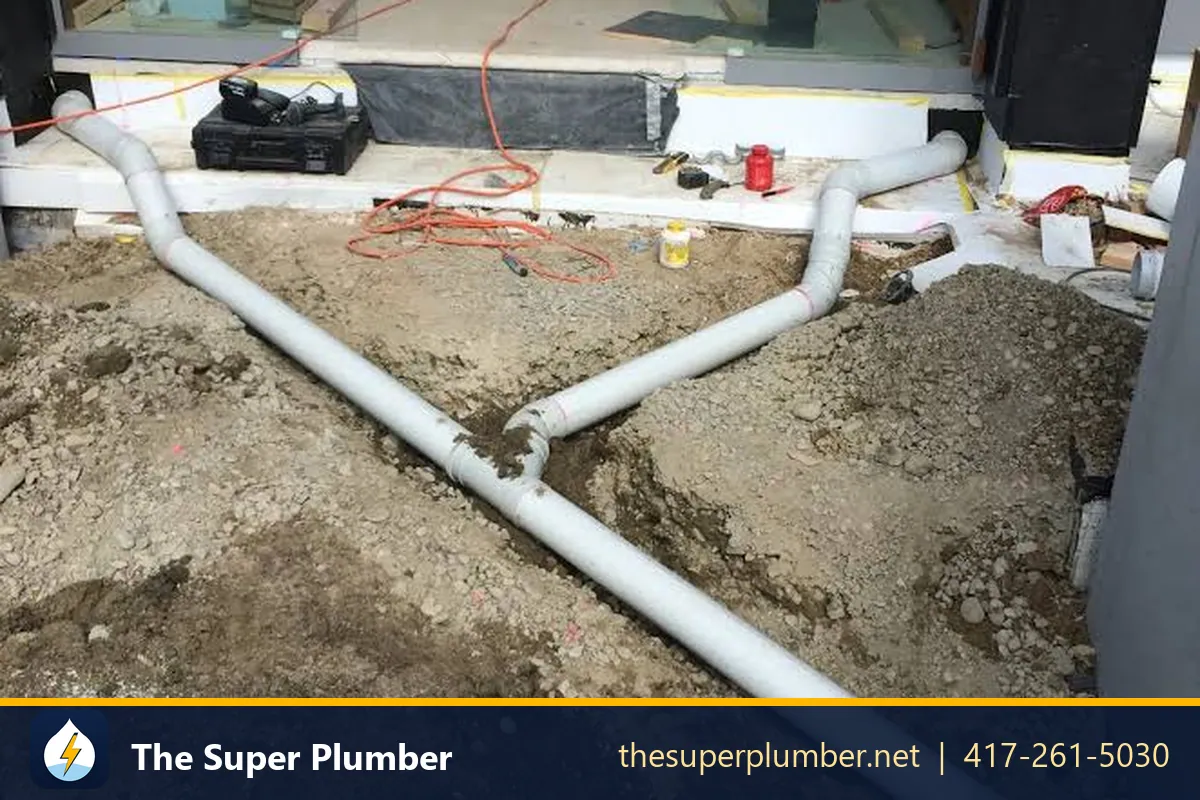
Access decides much of the labor. A crawlspace or basement lets a plumber run pipe below the floor; a slab home may need cutting, or routing through walls and attics. An addition on a slab often uses trenching to tie into existing drains.
Common installation mistakes to avoid
Most post-installation problems trace back to a few avoidable errors. Watching for them protects your investment.
Skipping the pressure and leak test
Supply piping should be tested before walls are closed, and drains checked for leaks and flow. A joint that weeps behind tile is a costly repair. Ask when the test happens and whether an inspector will see it.
Wrong fixture rough-in dimensions
Toilets, sinks and shower valves each have rough-in dimensions. Ordering fixtures after the pipes are placed, or changing models mid-project, leads to mismatches. Choose fixtures first and share the specs with the plumber.
Poor venting and undersized drains
A drain without an adequate vent gurgles and can siphon traps dry, letting sewer gas in. Undersized drain lines slow flow and clog sooner. These faults are hard to see and easy to build in, which is why inspections and camera checks matter.
Forgetting shutoff valves and cleanouts
Every fixture should have its own shutoff, and drain lines should have access points. Leaving them out saves a little now and costs more later.
Cost factors for plumbing installation
Costs vary widely with the scope and the property, so no honest number fits every job. The main factors are:
- The number and type of fixtures.
- Distance from existing supply and drain lines.
- Pipe material and fittings.
- Access through walls, floors, crawlspaces and slabs.
- Whether concrete must be cut for a new drain.
- Permit and inspection fees, which vary by location.
- Fixture quality and whether you supply them.
- Time of day and how quickly you want the work done.
- Repairs to walls, floors and finishes after plumbing work.
For more on how bills are built, see what affects plumber cost.
Commercial and multi-unit installation
Restaurants, shops, offices and apartment buildings have higher fixture counts, backflow requirements and code demands such as grease interceptors or accessible fixtures. See commercial plumbing for that work. For a home or rental, ask the plumber how the work affects other units or shared stacks.
How to choose an installer
Ask how the plumber approaches the job, not just the price. Good answers are specific.
- How will you lay out the rough-in, and what will you test before walls close?
- Who pulls the permit and books the inspection?
- What is included in the price, and what is a possible extra?
- Who supplies fixtures, and how are returns or defects handled?
- How will you protect the finishes and what happens if walls need repair?
Talk with local plumbers or look into the full range of plumbing services to see how projects and repairs are handled.

Myths about plumbing installation
- Myth: any plumbing can be moved anywhere. Fact: drains need slope and vents need a route, so structure and floor depth limit placement.
- Myth: new pipe never leaks. Fact: fittings, handling and pressure can cause early failures, which is why testing matters.
- Myth: a cheaper fixture is always the smarter buy. Fact: parts availability and fit affect long-term repair costs.
- Myth: permits are just paperwork. Fact: inspections are a second check on venting, slope, support and materials.
Caring for new plumbing after installation
New fixtures and pipe need a little attention in the first weeks. Check under sinks and around toilets and tub valves after a few days of use, because a slightly loose connection may only weep once it has been through heat cycles. Note where your main shutoff and fixture stops are, and label them. Keep the paperwork for permits, inspections and fixture models, since you will want it for resale, insurance and future repairs. Flush new lines and clean aerators once if debris from the work shows up in the water.
When installation trouble becomes an emergency
An installation project can uncover leaks, or a fresh connection can fail. If water is flowing and you cannot stop it, close the main shutoff and call. See emergency plumbing for urgent situations; availability is confirmed by phone, including for requests such as a 24 hour plumber or same day plumber.
What to have ready before you call
- A sketch or photos of the room and the layout you want.
- The fixtures or models you have chosen.
- The age and pipe material of the home, if known.
- Where the main shutoff and water heater are.
- Your timeline and any remodeling schedule with other trades.
- Any past plumbing problems in the area.
Where You Can Get Plumbing Installation & Remodel Plumbing Help
Plumbing calls are taken for 21 states, 1,511 cities and 3,769 ZIP codes. Pick your state, or look at a sample city and ZIP for each state; coverage for your exact address is confirmed by phone.
- Arizona
- California
- Colorado
- Connecticut
- Florida
- Georgia
- Idaho
- Illinois
- Maine
- Massachusetts
- Michigan
- Minnesota
- Missouri
- New Hampshire
- New Jersey
- New York
- North Carolina
- Ohio
- Texas
- Virginia
- Washington
| City | ZIP codes and places |
|---|---|
| Gilbert, AZ | 85233 about 5 miles from Mesa Arts Center; about 6 miles from Wilkes University, Mesa 85234 about 5 miles from Mesa Arts Center; about 6 miles from Wilkes University, Mesa |
| San Diego, CA | 92102 about 1.8 miles from Balboa Park; about 2.1 miles from Petco Park 92103 about 1 mile from San Diego Zoo; about 1.3 miles from San Diego Museum of Art |
| Boulder, CO | 80302 near Mind and Life Institute; about 1 mile from Naropa University 80310 near Naropa University; near Folsom Field |
| Cheshire, CT | 06408 about 2.3 miles from Albertus Magnus College; about 3.7 miles from Yale Law School 06410 about 5 miles from Mount Southington; about 6 miles from Quinnipiac University |
| Fort Lauderdale, FL | 33308 about 2.6 miles from Fort Lauderdale–Hollywood; about 2.6 miles from Museum of Discovery and Science 33309 near City College; about 1.1 miles from Chase Stadium |
| Decatur, GA | 30030 near Agnes Scott College; about 1.9 miles from East Lake Golf Club 30031 near Agnes Scott College; about 1.9 miles from Michael C. Carlos Museum |
| Eagle, ID | 83616 about 8 miles from Idaho Aquarium; about 10 miles from Idaho Central Arena |
| Naperville, IL | 60540 near Benedetti–Wehrli Stadium; near North Central College 60563 about 1.7 miles from North Central College; about 1.8 miles from Benedetti–Wehrli Stadium |
| Berwick, ME | 03901 about 3.8 miles from Skyhaven Airport; about 4.5 miles from Powderhouse Hill |
| Litchfield, MA | 02464 about 1.4 miles from Crystal Lake; about 1.5 miles from William James College 02479 near McLean Hospital; about 2.8 miles from Harvard–Smithsonian Center for Astrophysics |
| Mount Clemens, MI | 48043 about 2.5 miles from Selfridge Air National Guard Base; about 8 miles from Jimmy John's Field 48046 about 2.3 miles from Selfridge Air National Guard Base; about 8 miles from Jimmy John's Field |
| Maple Plain, MN | 55359 about 7 miles from Crown College; about 7 miles from Lake Minnetonka |
| Chesterfield, MO | 63005 about 3.2 miles from Hardee's Iceplex; about 3.9 miles from Logan University 63006 near Hardee's Iceplex; about 1.9 miles from Butterfly House, Missouri Botanical Garden |
| Hampton, NH | 03842 about 3.1 miles from Fuller Gardens; about 8 miles from Bartlett Museum, Inc. 03843 about 10 miles from University of New Hampshire; about 10 miles from Whittemore Center |
| Newark, NJ | 07101 near Newark Velodrome; about 1.2 miles from Seton Hall University 07102 near Newark City Hall; near Prudential Center |
| Manhasset, NY | 11030 near Manhasset Valley Park; about 1.3 miles from Flower Hill Village Park |
| Davidson, NC | 28035 near Davidson College; about 4.9 miles from Lake Norman 28036 about 3 miles from Davidson College; about 8 miles from Lake Norman |
| Groveport, OH | 43125 about 10 miles from Nationwide Arena; about 10 miles from ScottsMiracle-Gro Field 43199 near Huntington Park; near Nationwide Arena |
| Richmond, TX | 77406 about 9 miles from Constellation Field; about 23 miles from Reliant Stadium 77407 about 5 miles from Constellation Field; about 8 miles from Smart Financial Centre at Sugar Land |
| Yorktown, VA | 23690 about 1.9 miles from Endview Plantation Historic Site; about 2.7 miles from Virginia Institute of Marine Science 23691 about 2.9 miles from Virginia Institute of Marine Science; about 3 miles from Endview Plantation Historic Site |
| Federal Way, WA | 98003 about 4.7 miles from Highline College; about 5 miles from Surprise Lake 98063 about 4.6 miles from Highline College; about 5 miles from Surprise Lake |
Frequently Asked Questions
What does plumbing installation include?
It includes setting new fixtures, running supply and drain piping, connecting appliances, adding vents, installing shutoff valves and testing the work. New construction plumbing has a rough-in stage and a finish stage. Remodel work adds connecting to existing lines and working around finished surfaces.
How is new plumbing installation different from a remodel?
New construction has open walls and a free layout, so pipes can run efficiently. A remodel must connect to existing lines, work around finished surfaces and deal with older materials and surprises inside walls. That is why remodel estimates often carry more contingencies.
Do I need a permit for plumbing installation?
Usually yes, when plumbing is added, moved or replaced, and often for water heaters and gas work. Rules vary by city and county, and inspections commonly follow the rough-in and finish stages. Ask the plumber how permits are handled in your area.
What are the basic plumbing components in a house?
The supply side includes the main shutoff, pressure regulator, supply pipes and fixture shutoffs. The drain side includes traps, drain pipes, vents and cleanouts. Fixtures and appliances connect the two. Together they bring clean water in and carry waste out.
Which pipe material is best for a new installation?
There is no single best pipe. Copper and PEX are common for supply, while PVC or ABS are common for drains, and code and the application decide which are allowed. A plumber should explain why a material fits your project and how it connects to what exists.
What is a plumbing video inspection?
It is a camera inspection of the inside of a drain or sewer line. A small camera on a flexible cable shows cracks, roots, sags and blockages. It is helpful before a remodel, before buying a home or after repeated backups.
Can plumbing be moved during a bathroom remodel?
Often, but not without limits. Drains need slope and vents need a route, and joists and floor thickness restrict layout. Moving a toilet is generally the hardest relocation. A plumber can tell you what your layout allows and what it may cost in extra work.
When should I replace plumbing instead of repairing it?
Consider replacement when pipes are old, corrode, leak repeatedly or are made of a material you would rather not keep. Doing it during a remodel, while walls are open, can reduce disruption. A plumber can assess the condition and suggest partial or whole-house options.
How long does a plumbing installation take?
It depends on scope, access, permits and inspections. A single fixture swap is a small visit, while a remodel or new build spans stages over days or weeks. Timelines are confirmed by phone once the plumber understands the project.
Who supplies the fixtures for an installation?
It varies. Some homeowners buy fixtures themselves, while others have the plumber source them. Either way, confirm the model, rough-in dimensions and parts are compatible before the work starts, since a mismatch can delay the job.
Will plumbing work damage my walls or floors?
Some access holes are common, especially in remodels or older homes with hidden lines. A plumber should tell you where openings may be needed and whether repair is included. Ask before work begins so surprises are limited.
What happens if a leak appears after installation?
Shut off the fixture or the main valve and call the plumber promptly. Small leaks at connections are often quick to correct, while a leak inside a wall needs testing. Ask about warranty terms before the work; they are confirmed directly with the plumber.
Ready to talk to a plumber? Call 417-261-5030.
Call 417-261-5030