
Quick links
- Cold first: frost depth, freeze-ups and thaw leaks
- Emergency plumber Minnesota homeowners search for
- Maple Plain and the Lake Minnetonka side of Hennepin County
- Hard water, softeners and mineral scale
- Water heaters through long winters
- Sump pumps, ejector pits and basement water
- Wells, septic systems and rural properties
- Drains and sewer lines
- Leaks under floors and behind walls
- Toilets, faucets and the disposal
- Gas lines and winter heating
- Water lines, meters and backflow
- Winterizing a cabin or seasonal home
- Multi-family buildings, shops and rental units
- Cost factors and what to have ready
- Cities We Serve in Minnesota
- Related Plumbing Help
- Frequently Asked Questions
A plumber in Minnesota spends much of the year working against the cold, and that changes how homeowners should think about pipes, drains and water heaters. The Super Plumber takes calls for plumbing problems in the Maple Plain area west of Minneapolis and across the state, with coverage, pricing and availability confirmed when you phone and give your city, ZIP code and a short description of the problem.
Minnesota houses face deep frost, long heating seasons, hard water and, in lake and rural areas, private wells and septic systems. Below is a practical look at plumbing services in Minnesota: what goes wrong, what a plumbing contractor checks, how to protect a home through winter, and when a problem should be treated as an emergency.
Cold first: frost depth, freeze-ups and thaw leaks
Minnesota is one of the coldest states in the country, and frost depth is why buried water service lines are set well below the surface. Where a line sits too shallow, or a pipe runs through an unheated space, a hard freeze can stop the flow or split the pipe.
Where freezes actually happen
The usual trouble spots are pipes along exterior walls, in rim joist areas, in garages, in crawl spaces and behind kitchen or bath cabinets on outside walls. Outdoor hose bibs that were left connected are another common source of winter water damage.
What to do when water stops in a freeze
- Open the affected faucet so melting ice has somewhere to go.
- Warm the room and, if you can reach it, the pipe, using a hair dryer on low. Never use an open flame.
- Look for wet drywall, dripping ceilings or a pipe that has bowed or cracked.
- Shut off the main valve at the first sign of water leaking.
- Phone a plumber if the pipe is split, inaccessible or you cannot find the freeze.
A burst pipe repair often begins only after thawing, when water suddenly appears. That is the moment to close the main valve, not to wait.
Emergency plumber Minnesota homeowners search for
People searching for an emergency plumber Minnesota wide are usually dealing with a burst line, a sewage backup or no water in subzero weather. Guidance on emergency plumbing covers how to tell urgent from routine. Phrases like "24 hour plumber" or "same day plumber" are common searches, but whether either is possible is confirmed by phone, not promised in advance.
Life-safety problems come first
- Gas smell: leave the building, avoid switches and flames, and call the gas utility or 911 from outside.
- Sewage in living space: stop using water and avoid contact.
- Water near electrical panels: keep away and call emergency services.
Have a plumbing problem right now? Call and describe it.
Call 417-261-5030Maple Plain and the Lake Minnetonka side of Hennepin County
Maple Plain at ZIP 55359 (about 7 miles from Lake Minnetonka) is the ZIP the coverage list currently holds for Minnesota, so give that number if you live there. West-metro communities near the lake mix older cabin-style homes converted to year-round use, newer subdivisions and lakeshore properties, and each brings a different set of plumbing questions.
Converted lake homes
Cottages that became full-time residences may have thin-walled supply lines, small water heaters and drain lines sized for seasonal use. A plumber checks whether the fixtures added since then are supported by the piping behind them.
Newer homes farther from the lake
Newer construction generally has PEX supply lines and plastic drains, so calls tend toward water heater replacement, fixture leaks and disposal or faucet repair rather than corroded pipe.
Ice dams and roof-edge leaks
When snow melts on a warm roof and refreezes at the eaves, water can back up under shingles and run down inside walls. That is a roofing problem first, but wet insulation can hide a supply-line leak, so a plumber may be asked to rule plumbing in or out.
Hard water, softeners and mineral scale
Water in much of Minnesota is known to be hard, meaning it carries dissolved calcium and magnesium. Over time mineral scale coats water heater elements, clogs aerators and shortens the life of tank heaters.
- Sediment collects in the bottom of tanks and dulls efficiency.
- Scale narrows shower heads and faucet aerators.
- Softener brine and backwash lines need proper drain connections.
- Water heaters in hard-water homes often need attention sooner than the label suggests.
- Flushing a tank on a schedule can slow the buildup, though older tanks should be checked by a pro before draining.
Why scale matters to a water softener decision
A softener treats the water before it reaches the heater, but it needs a floor drain or standpipe and a salt or potassium supply. Ask a plumber where the drain line should go and whether a bypass valve is present.
Water heaters through long winters
Cold incoming water and long heating seasons put steady strain on tanks. A water heater repair near me search is often triggered by lukewarm water, a popping sound from sediment or a wet floor. See water heater replacement for how a failed tank is judged.
Tank or tankless
A tankless water heater installation in a cold climate depends on gas capacity, venting and the incoming water temperature. Fuel matters too: some rural homes look at propane tankless water heaters where natural gas is not available, and others consider an electric tankless unit where the electrical panel allows.
Signs a tank is near the end
- Rust-colored hot water.
- Moisture around the base or a dripping relief valve.
- Age past the manufacturer's expected life.
- Repeated repairs to the same part.
Sump pumps, ejector pits and basement water
The two pits in a basement
Many Minnesota homes have basements, and spring melt puts pressure on foundation drainage. A sump pump moves groundwater out of the pit, while a sewage ejector lifts wastewater from a basement bath to the sewer line. Both fail at bad times: during power outages and heavy thaws. Explore sump and well pump repair if yours cycles constantly, hums without pumping or has never been tested.
Ready to get a quote? Availability and pricing are confirmed by phone.
Call 417-261-5030Wells, septic systems and rural properties
Outside city limits, many properties run on a private well and a septic tank. Well pumps, pressure tanks and pressure switches are separate systems from the plumbing inside the house. If a house has low pressure, sputtering faucets or a pump that short-cycles, the trouble may be the well side.
- Never open pressurized lines or wiring on a well pump yourself.
- Septic backups can look like drain clogs but are not fixed by chemicals.
- Ask the plumber whether the problem is inside the house or outside it.
- Keep track of the last time the tank was pumped, since that date helps a technician diagnose a backup.
Drains and sewer lines
Clogs versus a failing line
Drain cleaning near me covers grease in kitchen lines, hair and soap scum in bathrooms and roots that reach older sewer laterals. The main methods are cabling, then hydro jetting for stubborn buildup, and camera inspection to find the cause.
What a camera shows
A sewer camera inspection shows cracks, belly sections and offsets. That evidence supports a decision on sewer line repair: patching, lining through trenchless pipe repair or full sewer line replacement. Frozen ground and access limit some digging in winter, which is one reason timing is discussed on the call.
Leaks under floors and behind walls
Hidden water loss shows up as a rising bill, a musty smell, a warm spot on a floor or a meter that moves when all fixtures are off. Leak detection services use acoustic tools and thermal imaging to find a leak without tearing out finished space. Read about leak detection and, for concrete floors, slab leak repair. Slab leaks are the exception in a basement state, but they occur in garage additions and slab-on-grade rooms.
Toilets, faucets and the disposal
Everyday fixture work
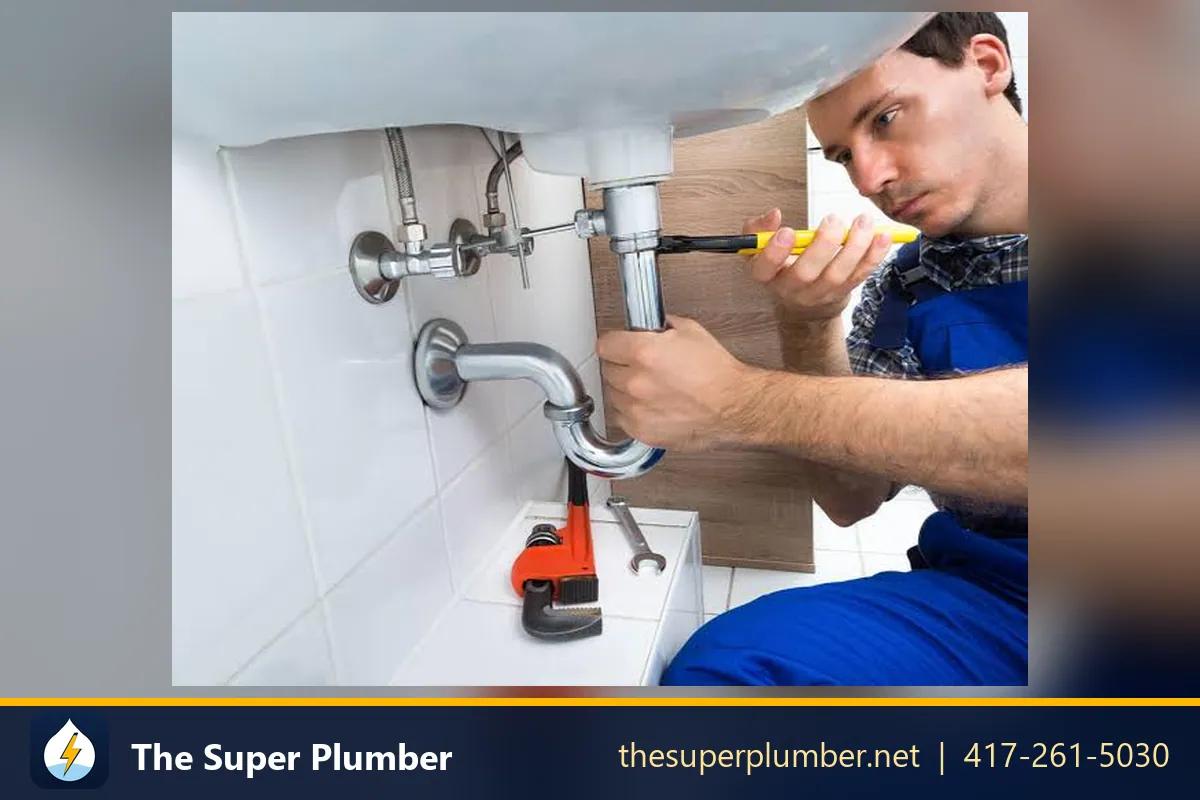
Fixtures are the routine end of plumbing work. Toilet repair covers a running tank, a soft flush or a loose base. If the bowl will not clear, toilet not flushing explains what to try and where to stop. Garbage disposal repair usually means a jam or a leaking seal, and an outdated kitchen faucet can be swapped in the same visit.
Water still running or a smell of gas? Act first, then call.
Call 417-261-5030Gas lines and winter heating
Furnaces, boilers, dryers and water heaters burn gas in many homes. Gas leak detection should always be left to professionals and the gas utility. Adding a range, fireplace or generator falls under gas line installation.
Water lines, meters and backflow
Service lines and shutoffs
The water service line runs from the street to the meter and into the house, and a break there can flood a yard or basement. Options for water main repair depend on depth, frozen ground and access. Irrigation and fire systems may also need backflow preventer testing, and cabins that close for winter need proper draining.
Winterizing a cabin or seasonal home
A seasonal property can freeze solid when heat is shut off, and lake homes are the classic example.
- Shut off and drain the main water supply.
- Open every faucet and drain low points.
- Address the water heater according to its manufacturer's instructions.
- Ask a plumber about traps, toilets and any antifreeze use rather than guessing.
Multi-family buildings, shops and rental units
Apartment buildings, small retail spaces and restaurants add shared risers, grease traps, floor drains and backflow assemblies to the usual residential list. A leak in one unit can affect neighbors below, so managers should say clearly whether the problem is isolated to one unit or affects the whole building.
- Tenants should report leaks and slow drains early so they do not spread.
- Owners should know where each building's shutoff valves are.
- Businesses should mention any hours when access is restricted.
- Restaurants should ask about grease interceptor cleaning schedules.
Cost factors and what to have ready
Quotes depend on access, pipe depth, materials, permits, fuel type and time of day, and figures are confirmed by phone. See plumber cost for the general factors.
Different callers need different things, so the more precise the description, the easier it is to match the right kind of visit. A short note about what you already tried, such as closing the main valve or clearing a trap, also saves time.
What to tell the phone team
- City and ZIP code.
- Symptom, start time and whether water is shut off.
- Home age and water source (city, well, or lake system).
- Water heater type, if known.
Cities We Serve in Minnesota
Plumbing calls are taken for 1 Minnesota cities and 1 ZIP codes. Cities with the most ZIP codes come first, with place notes; every other city follows, grouped by letter.
- Maple Plain
Maple Plain (1 ZIP code)
| ZIP code | Area | Nearby landmarks | County |
|---|---|---|---|
| 55359 | Maple Plain area | ▸ About 7 miles from Crown College ▸ About 7 miles from Lake Minnetonka ▸ About 23 miles from University of Minnesota | Hennepin |
Frequently Asked Questions
How do I get a plumber in Minnesota?
Phone and describe the problem, your city and your ZIP code. The phone team confirms whether your location is covered, how scheduling works and what pricing looks like. Nothing about availability is assumed in advance. Have the age of the home and the main shutoff location ready, since those details help decide what to send.
Which Minnesota ZIP code is covered?
The coverage list currently includes ZIP 55359 (about 7 miles from Lake Minnetonka) for Maple Plain. If you are elsewhere in the state, still call and describe where you are, since coverage is confirmed by phone rather than assumed from a list.
What should I do when a pipe freezes?
Open the faucet, warm the area safely and check for cracks. Never use an open flame on a frozen pipe. If you see water leaking, shut off the main valve and phone a plumber. A pipe that has split will leak as soon as ice melts, so it is smart to be near the shutoff while thawing.
Do I need a plumber for hard water problems?
For scale on fixtures, a softener or descaling may be enough, but a plumber can inspect the water heater, flush sediment properly and connect a softener correctly. Do not drain or work on a tank without following the manufacturer's steps.
How can I tell if my sump pump is working?
Lift the float or pour water into the pit to see if it starts and empties. A pump that is silent, cycling nonstop or vibrating heavily may be failing. Battery backups need testing too. Plumbers can service or replace pumps and check the discharge line.
Is a sewer camera inspection worth it?
For an older house, a recurring clog or before buying a property, a camera can show cracks, roots and sags. It replaces guesswork with a picture, which helps you choose between cleaning, lining and replacement.
When should I call for a gas smell?
Immediately, but from outside. Leave, avoid switches, phones near the odor and flames, and call the gas utility or 911. Do not try to find the leak. After the utility clears the building, a plumber can handle any piping repair.
Can a tankless heater run on propane?
Many models are available for propane, but the unit, venting and gas supply have to match. A plumber confirms the model, line size and regulator needs. Ask about installation requirements in your area, including venting and permits.
What causes low water pressure?
Possible causes include a partly closed valve, clogged aerators, mineral scale, a failing pressure regulator, a hidden leak or, with a well, a pump or pressure tank issue. A plumber tests the pressure at a hose bib and narrows down the cause.
Do you help landlords and businesses?
Yes, homeowners, landlords, property managers and business owners can all phone. See commercial plumbing for the types of building systems that come up.
Ready to talk to a plumber? Call 417-261-5030.
Call 417-261-5030