
Quick links
- Which Drain Cleaner Is Actually Best?
- Baking Soda and Vinegar: What It Does and What It Does Not
- Homemade and Natural Drain Cleaner Options
- Liquid Drain Cleaners and Chemical Openers: The Honest Risks
- Sink Drain Cleaner Options by Fixture
- Mechanical Tools That Work Better Than Most Bottles
- How to Clean Sink Pipes and Drains as Maintenance
- Drain Cleaner Myths Worth Dropping
- Older Homes, Rentals and Businesses
- When a Store Product Will Not Work
- Professional Drain Cleaner Service: What You Get
- Where You Can Get Help
- Related Plumbing Help
- Frequently Asked Questions
The best drain cleaner for most household clogs is not a bottle at all. A plunger, a plastic drain-strip tool and a cleaned P-trap solve the majority of sink, tub and shower clogs without risk to your pipes, your skin or your septic system. Chemical openers can work on a light clog, but they are the riskiest option, and they can make a plumber's job harder if they fail.
This is an honest look at each option: baking soda and vinegar, enzyme products, liquid and crystal chemicals, and mechanical tools. It says where each one helps, where it does not, which products should never be combined, and when a clog is telling you the problem is bigger than a sink drain. Where a clog keeps returning, professional cleaning is the next step.
Which Drain Cleaner Is Actually Best?
The best choice depends on what is clogging the pipe and where. Match the tool to the clog, and start with the least aggressive option.
- Hair in a tub or shower: a plastic drain-strip tool or a small hair snake, not a chemical
- Grease and soap in a kitchen sink: hot tap water, dish soap, a plunger and a cleaned trap
- Slow drain with no full clog: an enzyme-based cleaner, used regularly
- A completely stopped sink: a plunger with a good seal, then the trap
- A toilet: a flange plunger or a closet auger, never a chemical
- Several fixtures slow at once: stop, because that is a main line problem, not a drain cleaner problem
If none of that helps, a plumber can open the line with a cable or a jetter. See clogged drain service and drain cleaning for what professional service involves.
Baking Soda and Vinegar: What It Does and What It Does Not
A baking soda and vinegar mix is safe for pipes and cheap, but it is a mild cleaner, not a real drain clog remover. The fizzing looks impressive, yet the reaction mostly produces water, carbon dioxide and a little sodium acetate. It does not dissolve hair, and it barely touches thick grease.
What it can do
The fizz can loosen a light film of soap and organic matter near the drain opening, and the hot water flush afterward carries some of it away. It also freshens a drain that smells because of surface buildup. That is why the drain opener baking soda vinegar trick is so popular for maintenance.
How much vinegar and baking soda to use
For cleaning drains vinegar and baking soda together, a common approach is about a half cup of baking soda poured into the drain, followed by about a half cup of white vinegar. Cover the opening with a plug or wet cloth to keep the fizz going down. Wait about 15 minutes, then flush with hot tap water. Hot from the tap is enough; do not pour a kettle of boiling water into PVC or into a porcelain fixture that could crack.
Step by step
- Remove standing water from the sink or tub with a cup if you can.
- Pour in the baking soda and push it down with a spoon if needed.
- Add the vinegar and cover the drain.
- Wait about 15 minutes.
- Flush with hot water for a minute or two and test the drain.
- Repeat once, then move to a mechanical tool if the drain is still slow.
Where the limits are
When a clogged drain vinegar baking soda attempt fails, it is because the clog is hair, a solid clump, a dislodged bit of food or a blockage further down the line. Repeating the treatment five times will not change that.
Need a plumber in your area? Call to confirm coverage.
Call 417-261-5030Homemade and Natural Drain Cleaner Options
A homemade drain cleaner is not much more than the kitchen-cabinet list: baking soda, vinegar, salt, dish soap and hot water. Those are safe to use one at a time. They are a natural drain cleaner in the sense that they contain no harsh solvents, and they suit routine care.
Natural ways to clean drains
- Hot tap water and dish soap flushed after cooking cuts through fresh grease
- Baking soda and vinegar works for light buildup and odors
- Boiled-and-cooled water does not help much, and boiling water should not go into plastic pipe or a cracked fixture
- Enzyme cleaners use bacteria or enzymes to digest organic matter slowly; they work over hours and are best used as maintenance
A note on lemon, salt and other tricks
Lemon and salt smell nice, but they add little to a clog. If a DIY drain cleaner recipe includes bleach, ammonia, drain crystals or anything else, do not mix it. The next section explains why.
Liquid Drain Cleaners and Chemical Openers: The Honest Risks
A liquid drain cleaner dissolves hair and grease with strong chemistry, and that same chemistry can harm pipes, fixtures and you. These products typically rely on lye (sodium hydroxide), bleach or sulfuric acid, all of which are corrosive.
Why they can be dangerous
- Burns: splashback can injure skin and eyes, and vapors irritate breathing
- Heat: the reaction generates heat that can soften plastic pipe or crack old porcelain
- Standing water: if the drain is fully blocked, the chemical sits in the pipe or sink, and the next person to plunge or remove the trap may be splashed
- Septic systems: strong chemicals can harm the bacteria a septic tank relies on
- Aging pipes: repeated use can wear on older metal and worn joints
Never mix drain products
Never mix drain cleaners with each other or with vinegar, bleach or ammonia. Some combinations release toxic gas, and others react violently. If one product did not work, do not pour a second one on top. Ventilate the room, rinse per the label and let the residue drain before you try anything else. If fumes affect your breathing, get fresh air and call poison control or emergency services.
Tell your plumber
If you have used a chemical, say so when you call. The plumber will treat the drain as hazardous and wear protective gear, and the information may change the plan. Do not plunge or open the trap of a drain that holds chemical water.
How to read a label
The label names the active ingredient and the pipe types it is safe for. Use it only as directed, never in a toilet unless the product says so, and never combine it with a plunger. Keep it away from children and pets, and store it out of reach.
Sink Drain Cleaner Options by Fixture
A sink drain cleaner that works in a kitchen can be a poor fit for a shower. The clog is different, so the tool is different too.
Kitchen sinks
Kitchen clogs are almost always grease, soap and food particles. A drain cleaner for kitchen sink use case starts with a plunger and a cleaned P-trap; enzyme products help afterward. If the sink has a disposal, see garbage disposal repair and replacement, since a jammed unit can look like a clog. The best drain unclogger for kitchen sink problems is often a bucket, a wrench and ten minutes at the trap.
Bathroom sinks
Hair, toothpaste and soap collect on the pop-up stopper and just below it. Pull the stopper and clean it before you buy a drain cleaner for bathroom sink use. Many slow sinks are fixed by removing the gunk on the stopper linkage.
Showers and tubs
A drain cleaner for shower drain problems rarely beats a plastic drain-strip tool, because the clog is hair and soap. Lift the cover, pull out the hair mat and rinse. Chemical products can make a bathtub drain worse by leaving hair jellied in place. A baking soda vinegar bathtub drain treatment helps only with the surface film.
Toilets
A toilet clog cleaner in liquid form is a bad idea; a flange plunger or a closet auger is safer and more effective. If the toilet still will not clear, read about a toilet that will not flush.
Mechanical Tools That Work Better Than Most Bottles
A drain clog remover tool removes the clog instead of dissolving it, so it works when chemistry does not. These are the tools worth keeping at home.
- Cup plunger: for sinks and tubs; cover the overflow opening and seal well
- Flange plunger: for toilets
- Plastic drain-strip tool: a barbed strip that pulls hair from a shower or sink
- Hand-crank drain auger: a small cable for sink and tub traps
- Closet auger: made for toilets and less likely to scratch porcelain
- Bucket and wrench or channel-lock pliers: for removing the P-trap
Cleaning the P-trap
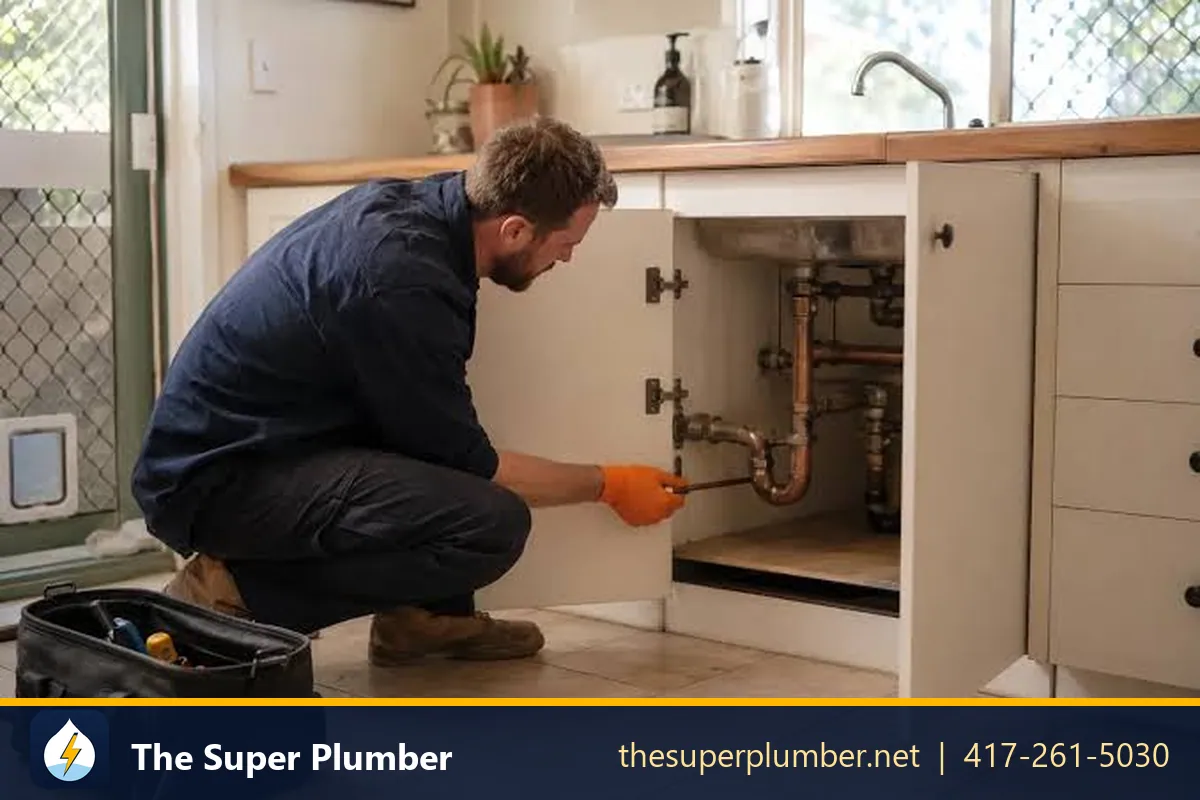
The P-trap is the curved pipe under a sink; it holds a water seal that blocks sewer gas. Put a bucket under it, loosen the slip nuts by hand or with pliers, and empty the trap. Clean out the gunk, check the washers and reassemble hand-tight. If a fitting is corroded, a bigger repair may be needed, and dripping faucet and sink repair is a good next read.
How to clean a kitchen drain pipe
To clean kitchen drain pipes beyond the trap, use a hand auger through the trap arm and flush with hot water and dish soap. If there is a dishwasher connection, check the air gap or high loop, since a blocked line there can back up into the sink.
Have a plumbing problem right now? Call and describe it.
Call 417-261-5030How to Clean Sink Pipes and Drains as Maintenance
Drain maintenance is easier than fixing a clog. A few habits keep most sinks and tubs flowing, and they cost almost nothing.
- Run hot water for a minute after washing dishes
- Wipe greasy pans with a paper towel before washing
- Use drain strainers in every sink and shower
- Pull the stopper and clean it every month or two
- Use an enzyme cleaner monthly on drains that clog often
- Flush the baking soda and vinegar mix through less-used drains to freshen them
- Do not put coffee grounds, eggshells or rice down the kitchen sink
Bathroom remodeling is also a good time to check the drain layout and traps; see bathroom remodel plumbing for what a plumber looks at.
Drain Cleaner Myths Worth Dropping
A few beliefs keep people pouring products that do nothing or do harm.
- Myth: if one cup of cleaner is good, two is better. Fact: extra chemical only raises the risk of splashback and pipe damage.
- Myth: boiling water fixes any clog. Fact: it can soften plastic pipe and crack fixtures, and it does nothing to hair.
- Myth: flushable wipes are drain-safe. Fact: they hold together far longer than paper and are a leading cause of blockages.
- Myth: a slow drain is not worth attention. Fact: it is often the first sign of a line that a sewer camera inspection could explain.

Older Homes, Rentals and Businesses
Old cast iron and galvanized drains have rough interiors that catch debris, so chemical use is less forgiving there. Renters should report a recurring clog to the landlord instead of pouring products, since a shared stack may be involved. Restaurants and shops face heavy grease loads that no bottle handles; see commercial plumbing services. If a failed clog reveals a corroded fitting or a leak under the sink, plumbing repair is the follow-up.
When a Store Product Will Not Work
Some clogs are not a clog. If drain cleaners keep failing, the problem is bigger than the drain opening.
- Several fixtures are slow or a toilet gurgles when the tub drains
- Water backs up in a floor drain or basement tub
- The clog returns within days of clearing
- A foul odor stays after cleaning
- The trap is clean and the drain is still slow
These point to a main line or branch problem, and a bottle will not reach it. That is when sewer line cleaning or hydro jetting is the correct tool.
Ready to get a quote? Availability and pricing are confirmed by phone.
Call 417-261-5030Professional Drain Cleaner Service: What You Get
A professional drain cleaner does not pour anything down the drain. The plumber finds out where the clog is, opens it with a cable or jetter and often checks the line with a camera. That is more reliable than chemicals and it protects your pipes.
Low cost drain cleaning: what really keeps costs down
Searching for low cost drain cleaning often leads to bottles and gimmicks. In practice, cost comes down to an accurate diagnosis: a simple trap clog is cheaper to clear than a root-filled main line. Ask what is included, and how the plumber prices a repeat visit. For factors that move the price, read about plumber cost.
If it is an emergency
Sewage backing up, water rising toward the floor or a strong sewer odor is a reason to stop and call, not to try one more product. See emergency plumbing for what to do while you wait. Availability is confirmed by phone.
Where You Can Get Best Drain Cleaners & Natural Drain Cleaning Help
Plumbing calls are taken for 21 states, 1,511 cities and 3,769 ZIP codes. Pick your state, or look at a sample city and ZIP for each state; coverage for your exact address is confirmed by phone.
- Arizona
- California
- Colorado
- Connecticut
- Florida
- Georgia
- Idaho
- Illinois
- Maine
- Massachusetts
- Michigan
- Minnesota
- Missouri
- New Hampshire
- New Jersey
- New York
- North Carolina
- Ohio
- Texas
- Virginia
- Washington
| City | ZIP codes and places |
|---|---|
| Gilbert, AZ | 85233 about 5 miles from Mesa Arts Center; about 6 miles from Wilkes University, Mesa 85234 about 5 miles from Mesa Arts Center; about 6 miles from Wilkes University, Mesa |
| San Francisco, CA | 94102 near Asian Art Museum of San Francisco; near University of California College of the Law, San Francisco 94103 near Slim's; near California Institute of Integral Studies |
| Broomfield, CO | 80020 about 1.9 miles from 1stBank Center; about 2.6 miles from Butterfly Pavilion 80021 about 1.6 miles from Rocky Mountain Metropolitan Airport; about 2 miles from 1stBank Center |
| Greens Farms, CT | 06436 about 7 miles from Aldrich Contemporary Art Museum; about 8 miles from Western Connecticut State University 06838 about 2.2 miles from Westport Country Playhouse; about 4.2 miles from Rafferty Stadium |
| Boca Raton, FL | 33427 near Eleanor R. Baldwin Arena; near FAU Stadium 33428 about 6 miles from Butterfly World; about 7 miles from Morikami Museum and Japanese Gardens |
| Alpharetta, GA | 30004 about 7 miles from Roswell Recreation and Parks; about 8 miles from Barrington Hall 30005 about 6 miles from Atlanta Athletic Club; about 8 miles from Roswell Recreation and Parks |
| Nampa, ID | 83651 about 1.8 miles from Northwest Nazarene University; about 3.1 miles from Nampa Municipal Airport 83652 about 4.6 miles from Caldwell Industrial Airport; about 4.7 miles from College of Idaho |
| Schaumburg, IL | 60159 about 3.3 miles from Wintrust Field; about 5 miles from Medinah Country Club 60168 about 3.3 miles from Wintrust Field; about 5 miles from Medinah Country Club |
| Eliot, ME | 03903 about 4 miles from Prescott Park; about 4.1 miles from Strawbery Banke |
| Barrington, MA | 02101 about 1.2 miles from Logan International Airport; about 1.8 miles from Boston Public Library 02106 near Fisher College; near Boston Public Garden |
| Center Line, MI | 48015 about 3.2 miles from Hazel Park Raceway; about 7 miles from University of Detroit Mercy |
| Maple Plain, MN | 55359 about 7 miles from Crown College; about 7 miles from Lake Minnetonka |
| O Fallon, MO | 63366 about 4.9 miles from Midwest University; about 6 miles from Wentzville Ice Arena 63368 about 8 miles from Midwest University; about 8 miles from Wentzville Ice Arena |
| Rochester, NH | 03839 about 3.1 miles from Skyhaven Airport; about 9 miles from Whittemore Center 03866 about 2.7 miles from Skyhaven Airport; about 10 miles from Powderhouse Hill |
| Clifton, NJ | 07011 about 2.1 miles from Lambert Castle; about 3.2 miles from Montclair State University 07012 near Yantacaw Brook Park, New Jersey; about 2.1 miles from Montclair State University |
| Old Westbury, NY | 11568 near State University of New York at Old Westbury; about 1.1 miles from Old Westbury Gardens |
| Kannapolis, NC | 28081 about 3.9 miles from CMC-NorthEast Stadium; about 11 miles from Charlotte Motor Speedway 28082 about 8 miles from Charlotte Motor Speedway; about 19 miles from Spectrum Center |
| Dayton, OH | 45402 near Schuster Performing Arts Center; near Day Air Ballpark 45404 near Dayton Children's Hospital; about 1.9 miles from Day Air Ballpark |
| Katy, TX | 77449 about 6 miles from Richard E. Berry Educational Support Center; about 7 miles from Bear Creek Pioneers Park 77450 about 8 miles from Don Coleman Coliseum; about 8 miles from Bear Creek Pioneers Park |
| Yorktown, VA | 23690 about 1.9 miles from Endview Plantation Historic Site; about 2.7 miles from Virginia Institute of Marine Science 23691 about 2.9 miles from Virginia Institute of Marine Science; about 3 miles from Endview Plantation Historic Site |
| Tacoma, WA | 98402 near Tacoma Art Museum; near University of Washington Tacoma 98403 near Stadium Bowl; about 1.2 miles from University of Puget Sound |
Frequently Asked Questions
What is the best drain cleaner for a clogged sink?
For most sinks the best option is mechanical: a plunger, then a cleaned P-trap or a small hand auger. Enzyme cleaners are a gentle follow-up for maintenance. Strong chemical products are the last resort and carry real risks. If none of these work, the clog is deeper than a sink cleaner can reach.
Does baking soda and vinegar really unclog a drain?
It can loosen a light film of soap or organic residue, and it freshens a drain, but it rarely clears a real clog. The reaction mostly produces water, carbon dioxide and a small amount of sodium acetate, none of which dissolves hair or thick grease. Use it for maintenance, not as a substitute for a plunger or a plumber.
How much baking soda and vinegar should I use to clean a drain?
A common approach is about a half cup of baking soda followed by about a half cup of white vinegar, covered for roughly 15 minutes, then flushed with hot tap water. Repeating once is fine. If the drain is still slow, switch to a mechanical tool, since more fizz will not change the result.
Can I use baking soda and vinegar after a chemical drain cleaner?
No. Do not add anything to a drain that holds a chemical cleaner. Mixing products can release gas or spatter caustic liquid. Ventilate the room, follow the label rinse instructions and wait. If the drain is still blocked, tell a plumber what was used before anyone opens the trap.
Are liquid drain cleaners safe for pipes?
They can be harsh. Lye, bleach and acid products may heat and soften plastic, wear on old metal pipe and damage fixtures. They also endanger you by splashing. Follow the label exactly, never mix products and avoid them entirely on septic systems or in a fully blocked drain with standing water.
What is the safest drain cleaner?
The safest options are physical: plunging, a drain-strip tool, cleaning the trap and running hot water. Enzyme and baking soda methods are gentle chemically. No product is safe if it is mixed or misused, so always read the label and keep children and pets away.
How do I clean a sink drain without chemicals?
Remove the stopper or strainer and clean it, plunge with a good seal, then clean the P-trap over a bucket. A hand auger can reach a bit farther. Flush with hot tap water and dish soap afterward. This works for most bathroom and kitchen sink clogs.
Can I use drain cleaner in a toilet?
Usually not. Toilets rely on a plunger or a closet auger, and chemicals can splash, heat the bowl and create a hazard for whoever works on the toilet next. If a toilet keeps clogging, the trap, the flange or the drain line may need attention.
Is a natural drain cleaner as good as a chemical one?
Natural products are far safer, but they are gentler. They handle odors and light film, not solid clogs. Chemicals clear stronger clogs faster but carry health and pipe risks. Mechanical tools are usually the best middle ground for a real blockage.
When should I stop using drain cleaner and call a plumber?
Stop when more than one fixture is slow, when a toilet gurgles, when water backs up in a floor drain, when the clog returns quickly or when you have already used a chemical product without success. A plumber can clear the line and check whether a deeper problem is causing it.
Will a plumber use drain cleaner on my pipes?
Generally no. Plumbers commonly use cables, augers, water jets and cameras, which clear the clog and let them see the pipe. Bringing in a plumber after a failed chemical attempt is fine, but mention the product so they can take precautions.
Ready to talk to a plumber? Call 417-261-5030.
Call 417-261-5030